The Algarve on a coast-and-town itinerary
The Algarve is more than a sequence of beaches. Alternate coastal scenery with old-town streets, and let tides, heat and trail conditions decide how close to the water you go.
Inside this story
The Algarve is easier to understand as a series of different coastal settings than as one long beach resort. A western town stay and an eastern lagoon stay can produce quite different holidays even within the same region. The first important decision is therefore which landscape and daily rhythm you want nearby. Once that is clear, alternate time by the water with town streets, meals and indoor visits. Allow swimming conditions, wind and trail notices to alter individual outings. The result is a coast-and-town itinerary in which a canceled boat trip or an unsuitable beach does not leave a hole in the entire holiday.
- Lagos offers a town base with access to several coastal areas.
- Boat outings depend on conditions and should not be treated as guaranteed.
- Combining the far east and west in one day creates unnecessary road time.
Choose the east or west before choosing the hotel
Lagos and Tavira make useful examples of the region's variety. They are not interchangeable bases simply because both provide access to the Algarve coast. Look at the immediate town environment, the route to the shore and the wider outings you hope to make. If a protected lagoon landscape appeals more than repeated cliff scenery, let that interest shape the accommodation search. If you want a town-centered stay near western coastal areas, work from that geography instead of drawing an enormous circle around the entire region.
Trying to combine the far east and west in a single day's sightseeing often turns variety into road time. A longer trip can use two bases, but a short one may be better spent learning one area properly. Before booking, imagine a day with no major excursion: where would you walk, eat and rest? That ordinary day is a strong test of a base. Check the exact location of the room relative to transport and food, especially if it is marketed under a nearby town's name while standing well outside its center. Geography matters more than a photograph of the pool.
Put Lagos back into a coastal visit
A town base should be used as more than a place to collect keys and park. Leave a morning or afternoon for streets, civic spaces and an appropriate cultural stop, with a meal placed naturally along the route. This gives the coastline a human setting and provides an alternative when heat, rain or wind makes an exposed excursion less appealing. Check the chosen collection's current access directly rather than assuming all indoor attractions share a schedule.
Walking from town toward a coastal area can work well where there is a suitable public route, but examine the complete journey. A short straight-line distance may include steps, a busy road or an awkward return with tired children. Do not let the idea of a car-free day obscure the need to assess surfaces and shade. Likewise, a driving day should not consist of repeated attempts to park at each successive beach. Choose one worthwhile coastal destination and allow time there. Returning to town with energy for dinner can be more satisfying than making a final roadside stop simply because it appears close on the map.
Read the cliff path before following it
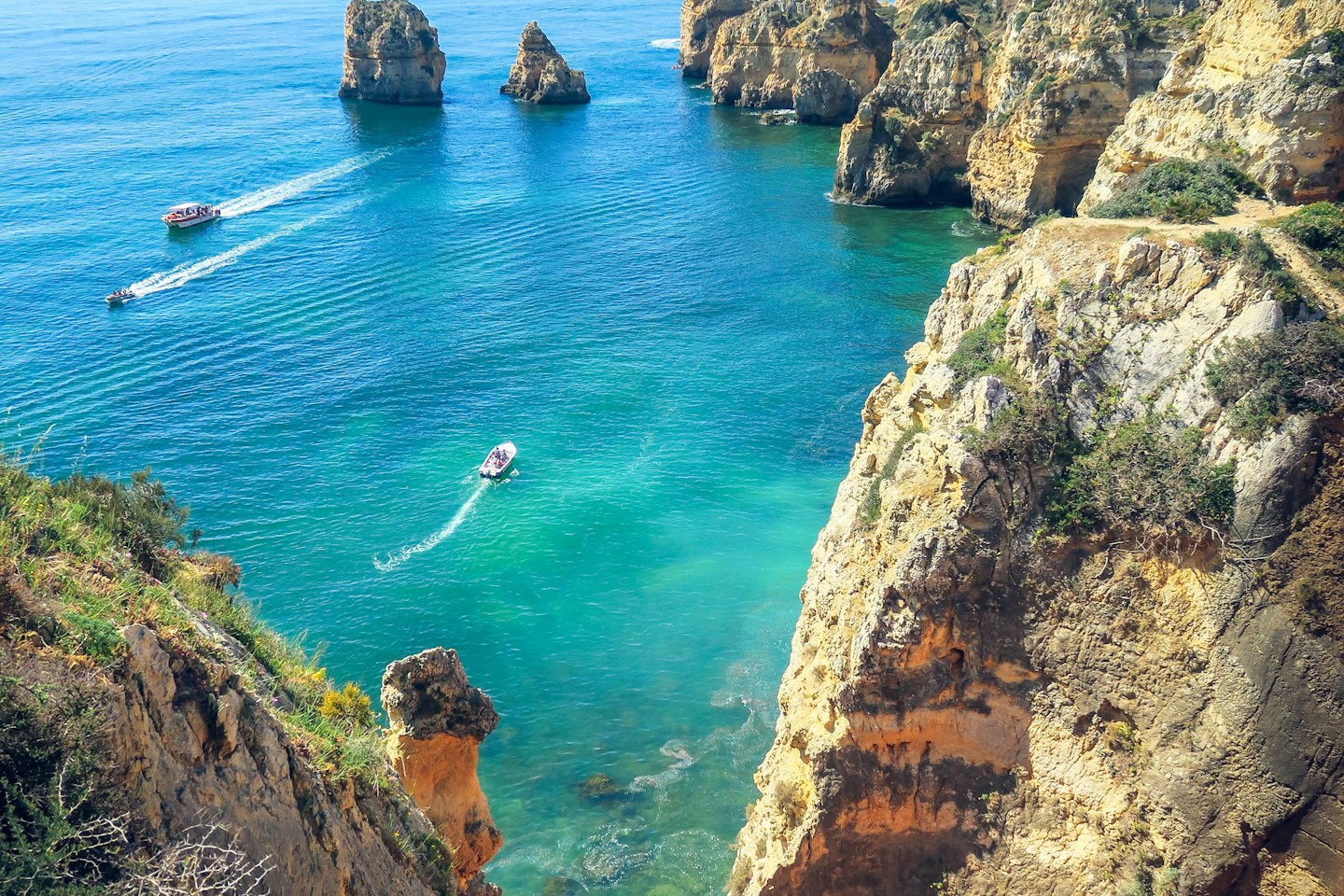
Cliff scenery is one of the Algarve's most recognizable attractions, but paths above the sea deserve deliberate choices. Stay back from edges and follow signs, barriers and closures. Ground that appears firm in an image may be unstable, and a visible trail is not evidence that access is permitted. Choose a route for its length, surface, exposure and current condition rather than because it connects several named beaches in one line.
Clothing and water should match the walk, not just the destination town. Exposed sections may offer little shade, while the return can feel substantially harder in rising heat. Start with a shorter route if you do not know how the group will respond. An out-and-back walk can be useful because you can turn around without depending on a complicated onward connection. A safe signed viewpoint is a complete encounter with the coastline; it does not need to be improved by stepping beyond a barrier. The view gains depth through looking at the layers of land, the movement of water and the changing direction of light, none of which require a dangerous position.
Count the stairs twice
A beach below a cliff can be beautiful and inconvenient at the same time. Before descending, think through the climb back with bags, wet clothing and people who have spent hours in the sun. Stairs, uneven approaches and distances from parking or bus stops can transform a supposedly easy beach day. Travelers with mobility needs should seek specific access information rather than accept a general description such as family-friendly or close to the sea.
Services matter too. Establish whether food, water, shade and toilets are available, and carry what is necessary when they are not. Check flags and local advice before swimming; an inviting appearance does not establish safe conditions. Keep children within an appropriate level of supervision and do not substitute other people's behavior for an assessment. If the chosen beach fails the day's practical test, a town lunch and a shorter waterfront walk are reasonable alternatives. The region's appeal does not depend on reaching the bottom of every staircase. Selecting a beach that the whole group can enjoy and leave comfortably is a more useful success than choosing the most secluded-looking cove.
Let the Ria Formosa change your scale of attention
A lagoon landscape asks for a different kind of looking from a cliff viewpoint. Water channels, low horizons and bird habitat reward patience and appropriate distance. Begin with current information about the protected area and choose an authorized walk or responsible excursion that suits the conditions. Stay on signed routes and avoid crossing sensitive ground to get closer to wildlife. A quiet observation from a permitted place can reveal more than repeatedly disturbing birds in pursuit of a sharper picture.
Boat outings should be understood in terms of their actual route, duration and operating conditions. Ask where they leave from, what the trip includes and how changes or cancellations are handled. Do not assume that every boat advertised under the same landscape name offers the same experience. The eastern coast can support a slower day combining a town walk, lagoon interpretation and a meal without needing to add a long journey west. This is where resisting regional completion pays off. The lagoon remains a place with ecological structure and everyday human use, rather than a decorative contrast squeezed between more famous photographs elsewhere.
Give Tavira an unhurried afternoon
Tavira can provide a useful eastern town focus, particularly when the itinerary needs an alternative to another full beach day. Build a walk around a few public places and one interior or collection that interests you, leaving enough space for a seated break. The aim is not to reproduce a town checklist but to notice how streets, water and ordinary commerce relate. A museum can give context that a series of façades does not, while also providing shelter during less comfortable weather.
Check the route to your accommodation and any onward transport before dinner if you are visiting from elsewhere. A charming evening becomes stressful when the return depends on an unconfirmed late service. If staying locally, make use of that advantage by returning to the same streets at another time of day. Familiarity exposes details missed during a first orientation: an entrance, the shade along a route or a small business preparing to close. Repeating a short walk is not a failure to explore. It is often the point at which a destination begins to feel like a place rather than a sequence of introductions.
Treat marine outings as optional appointments
A boat trip can be memorable, but it is dependent on conditions and operator decisions. Keep the rest of the day light enough that a changed departure or cancellation can be handled calmly. Ask about safety equipment, suitability for your group and what happens if the intended route cannot operate. A reservation confirms an arrangement; it does not make the sea behave according to the schedule.
Avoid responding to a cancellation by seeking an improvised alternative from an operator willing to ignore the conditions. Choose a land outing appropriate to the same weather, remembering that an exposed cliff path may also be unsuitable. Food, interpretation and town time are strong alternatives when selected with genuine interest. It helps to identify them early rather than construct them resentfully at the harbor. On a longer stay, leave one possible date for a second attempt without promising that it must happen. That balance keeps the marine excursion in proportion: a rewarding part of the Algarve if conditions allow, alongside many other ways to understand the coast.
Design a week with fewer daily departures
A satisfying week might alternate a coastal walk, a town day, a beach day and a protected-landscape outing, adjusting their order as conditions change. It does not need an equal number of attractions each day. Build a longer lunch into a shorter outing and leave a recovery afternoon after a demanding walk. Families benefit from days whose practical character is predictable, even when the destination changes: known transport, enough water and no surprise staircase at the end.
Start regional research with visitalgarve.pt and confirm specific trail, beach and transport arrangements through the relevant current sources. Keep the last day close enough to your departure route that a delayed meal or missed connection does not become a larger problem. By then, the region should have acquired distinctions: the town you know best, the type of shore you prefer and the conditions under which an outing feels good. Those distinctions are more useful than a claim to have seen the whole Algarve. They also leave a convincing reason to return to another part of the coast rather than trying to consume it all at once.
A few practical questions
Can the eastern and western Algarve be combined in one day?
They can involve considerable transfer time. For most short stays, concentrating on one area gives more useful time for walking, meals and the actual coast.
What makes a beach suitable for the group?
Consider access, the return climb, shade, services and current swimming guidance together. A beautiful image says little about any of those practical factors.
For current destination information, access guidance and local updates, visit the official Algarve travel resource. Check transport and attraction details directly before booking.
This is a general planning guide, not a live conditions report. Found something that needs updating? Send a correction.