Vienna to the lakes: an Austrian rail itinerary with breathing room
An Austrian rail trip can connect a cultural capital with a slower lake stay. The key is to treat the transfer as part of the holiday and to avoid making every scenic town a separate overnight stop.
Inside this story
An Austrian rail itinerary can gain its character from a simple change of scale: several days in Vienna, a distinct cultural stay in Salzburg and time beside a lake. The railway connects those settings, while local buses or boats may complete the journey. The most comfortable version keeps the number of rooms modest. It lets a city become familiar before exchanging its museums and streets for a different rhythm of weather, water and walking.
Avoid making every appealing town a separate overnight destination. A new room brings packing, station approaches and another set of arrival questions. Choose bases with enough substance to support both the intended activities and an ordinary tired afternoon. Salzburg deserves particular care here: it can be a real city stay between Vienna and the lakes, rather than merely the place where the traveler changes to the next service.
- Vienna deserves several neighborhood-scale days rather than a single landmark circuit.
- Regional services and long-distance trains have different reservation arrangements.
- A final night close to the departure city can reduce the risk of a tight onward connection.
Vienna needs days with different centers
Vienna is more manageable when each day has a geographic focus. A museum-rich section around the Ringstrasse can be one chapter, while another day explores a different neighborhood and its everyday streets. Do not use the presence of efficient transport as a reason to cross the city after every visit. The time saved by grouping places can become time inside a collection or at a table rather than another opportunity to add a distant entrance.
Choose museums by interest and give a substantial collection enough attention to justify being there. Check current exhibitions and opening arrangements before deciding the order. A café pause can provide a useful interval between periods of looking, but it should fit the neighborhood rather than require another long detour. With several nights in one base, there is also room to revisit a public space whose relationship to the city becomes clearer. Vienna then gains a recognizable daily geography before the journey moves west.
A transfer to Salzburg is the main movement of its day
Check the actual long-distance service, station and fare conditions for the intended date. Ticket flexibility and seat arrangements should be understood before a spontaneous change of plan. Do not assume that a pass, a ticket and a reserved place are the same product. Keep the confirmation accessible and choose a connection that suits the group's luggage and boarding needs rather than relying only on the shortest journey shown.
After arriving in Salzburg, allow time to reach accommodation, eat and make a short first walk. A major cultural visit need not be attached to the same afternoon. This protects the pleasure of arrival from the possibility of a delayed train and gives the new city a gentler introduction. An evening close to the room can be enough: familiarizing yourself with the route back and the local transport makes the following full day easier. The transfer has already contributed a meaningful change of setting.
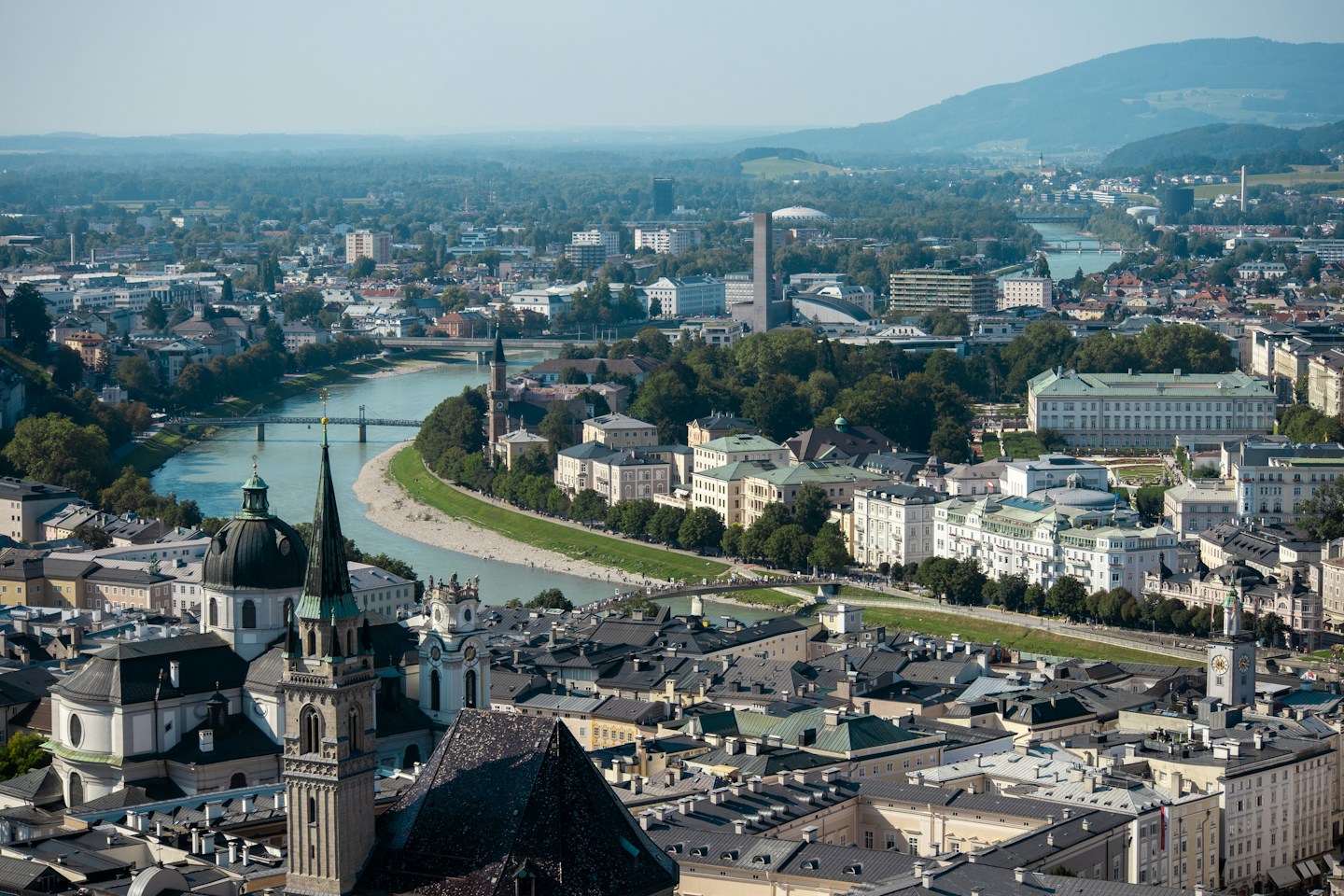
Read Salzburg across the Salzach
The Salzach provides an orientation line through Salzburg, but the city should not be reduced to a river panorama. Use a public crossing to relate the streets on either side, then choose an area to explore more closely. The historic center, Mirabell setting and surrounding neighborhoods offer different kinds of walking. A route can remain compact while still including enough stops and changes of level to take substantial time.
Look at how the more enclosed streets connect with open squares and river space. A celebrated view becomes more interesting once the approach to it is understood. Avoid blocking a bridge or narrow pavement while consulting a map. If a higher outing is planned, check its access and return separately instead of assuming every elevated landmark is a simple continuation of a level city circuit. The walk should fit the least confident member of the group, leaving enough energy for the cultural subject that brought everyone there.
Give Salzburg a cultural question
Music, architecture and collections can all organize a Salzburg stay, but they lead to different choices. A traveler interested in musical history may want a particular institution or performance; another may prefer buildings and urban history. Read what a ticket includes and what is actually presented before booking. A famous association is a starting point for curiosity, not a complete description of an experience.
If attending a performance, understand its duration, location and any practical expectations. Leave dinner and the return route compatible with the event. A late cultural evening pairs better with an unhurried next morning than with an early lake transfer. Travelers who do not choose a formal performance can still give music a place through interpretation and selected visits. The city becomes more substantial when one subject is followed with attention rather than every possible association being collected as a quick stop.
The lake is a destination with a last mile
Choose the actual lakeside settlement before selecting a hotel or transport product. The Salzkammergut is a broad region with different rail, bus and boat approaches. A lake-view room may lie well away from the station, and the final connection can determine whether a car-free stay feels easy. Ask accommodation staff for an exact public-transport approach and what happens after the last scheduled service.
Wolfgangsee illustrates this mixed-mode geography. Official regional guidance describes a bus approach from Salzburg, while travel around the lake may involve local connections or a boat. Check the current timetable for the precise place you intend to stay rather than assuming the lake name identifies a single stop. If several transfers are involved, simplify the rest of arrival day. A room reached comfortably and a short local walk make a better beginning than adding a distant viewpoint before the luggage has been put down.
A lake stay needs something beyond a clear summit
Mountain views can be a major pleasure, but a lakeside base should also work when cloud obscures them. Look for public walks, a settlement with ordinary services and an indoor or sheltered activity that actually interests you. A longer stay gives conditions room to change without requiring every day to succeed in the same way. A gentle shore walk can be a complete outing rather than a consolation for missing a high excursion.
A boat trip offers another perspective, subject to its own operation and weather. Confirm the departure landing, destination and return rather than treating the water as an unlimited substitute for road transport. If the outing includes a visit in another settlement, count time for the approach from the pier and any waiting. The lake can become more intelligible through one well-chosen journey than through repeated boarding and disembarking designed mainly to include every village name.
Mountain transport leaves a walking decision
A railway, lift or cable car may remove much of an ascent while leaving rough ground, exposure or seasonal conditions beyond the top station. Investigate the actual outing rather than judging it by a photograph taken from the viewing area. Ask about current access, surfaces and facilities. Travelers who want only a view should confirm that the station setting itself suits them without needing to undertake a walk intended for different abilities.
Use weather information and local advice close to the departure, and accept that an excursion can be postponed or replaced. The advantage of a multi-night lake base is the opportunity to choose a better window when one exists. Do not let a reservation elsewhere force a difficult descent or a hurried return. A mountain day should have a realistic turnaround and connection plan, with enough room for the group to move carefully. The ride up and the route after it are related experiences with separate practical demands.
Fare comparisons belong after the itinerary
Once the bases and major journeys are fixed, compare tickets, passes and local products against what the group actually intends to use. Check coverage for buses, boats and mountain services individually where they affect the budget. A broad promise of regional travel may contain distinctions that matter for a particular outing. Ask the operator or issuing body when the description is unclear rather than relying on a general travel summary.
Convenience and flexibility have value alongside price. A traveler planning fixed transfers may choose differently from someone hoping to move an outdoor outing according to the weather. Consider cancellation conditions and any separately required reservation. Do not add journeys simply to make a product appear economical. The money is supporting time in Vienna, Salzburg and a lake setting; if comparing passes begins to turn every day into transport, return to the purpose of the stay and simplify the calculation.
Return toward departure before the margin disappears
A final international connection deserves more room than an optional local excursion. If departure is from Vienna or another distant gateway, consider a final night near that route rather than relying on a chain of lake transport and mainline services on the same morning. The return can have a small pleasure of its own: a familiar neighborhood meal, another look at a collection or a calm walk after unpacking the essentials.
The journey's contrast should remain clear at the end. Vienna offered time with major cultural subjects, Salzburg a different urban scale and the lake a chance to respond to weather and landscape. Rail, buses and boats made those chapters fit together, but the meaningful result is the time spent inside them. A restrained route leaves enough energy to remember particular streets, rooms and water views. That is a stronger measure of an Austrian rail holiday than the number of scenic towns in which a suitcase was briefly opened.
A few practical questions
Must a lake stay be added after Salzburg?
No. Add it when you want a different pace and can give it enough nights to justify the transfer. Salzburg can also support a city-based stay with a carefully planned regional outing, depending on current transport and your interests.
Is staying beside a lake automatically convenient without a car?
Check the exact settlement and property. The main train may be followed by a bus, boat or substantial walk. A precise arrival and meal plan matters more than a general description of the hotel as lakeside.
For current destination information, access guidance and local updates, visit the official Austria travel resource. Check transport and attraction details directly before booking.
This is a general planning guide, not a live conditions report. Found something that needs updating? Send a correction.