Hoi An after the lantern photograph
Hoi An’s familiar lantern scenes are only one layer of a small trading-town landscape. Give the historic streets a quieter morning, then connect them with food, crafts and the surrounding countryside.
Inside this story
Hoi An's lanterns offer an easy image to remember, but they are a poor substitute for understanding the town. In daylight, shopfronts, religious spaces, river edges and domestic buildings reveal a place shaped by trade and continuing everyday use. The evening scene is more rewarding after those relationships have become visible. Plan for two different encounters with the same streets rather than treating darkness as the only worthwhile moment.
A longer stay also creates room for making and growing: a tailoring appointment, an ingredient-focused cooking activity or a carefully chosen route through nearby agricultural land. These experiences require different kinds of attention and different practical arrangements. Keep their scale modest. A town that looks compact can still become exhausting when heat, fittings, crowds and transport are compressed into a single day.
- The old town is a managed heritage area with ticketing and access arrangements to check.
- Cooking activities should explain ingredients and accommodate dietary needs.
- A shaded afternoon pause can make an evening walk more enjoyable than a nonstop sightseeing day.
Start when the town is preparing itself
A morning walk changes what draws the eye. Without relying on the lantern display, you can notice entrances, rooflines and the way narrow buildings meet the street. Businesses preparing for the day create a different rhythm from the evening visitor flow. Stay out of doorways while looking, and ask before photographing people at close range. The point is to observe ordinary activity without turning it into an obligation for someone else to perform.
Check the current arrangements for visiting the managed heritage area and individual buildings. A ticket may govern particular interiors rather than function as an all-purpose entitlement to every threshold. Choose a small selection that interests you and read the interpretation carefully. Historic houses and religious buildings deserve time beyond a quick photograph, and their access conditions may differ. Respect a closed room or a request to remove shoes even if another building on the same walk operated differently.
Trading history is visible in relationships
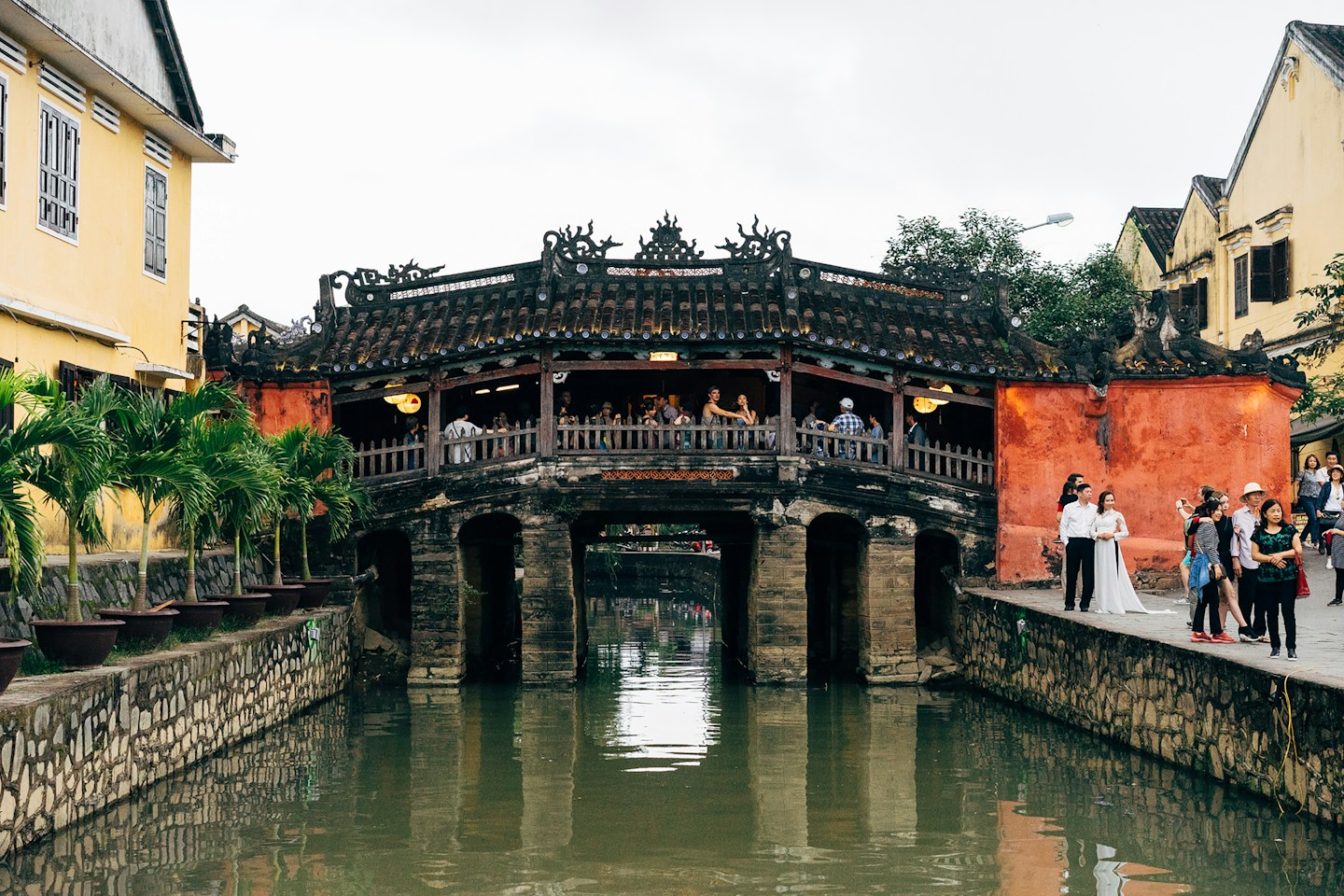
Hoi An's surviving fabric records a trading port active from the fifteenth through the nineteenth centuries. UNESCO identifies the meeting of local building traditions with Chinese, Japanese and later European influences as central to its significance. The streets follow a pattern related to commerce and the river: buildings could address customers on one side while goods moved through the waterfront side. Timber-framed houses, religious structures and the Japanese covered bridge belong to this larger mercantile setting. Look for relationships between street, building and quay rather than assigning every decorative detail to a single foreign influence. Trade created connections, and the architecture records their overlap.
Rather than trying to memorize every architectural label, ask how the town's spaces work together. Where does a street meet the river? Which buildings combine commercial frontage with an interior space? How do public crossings connect different parts of the center? A guide or well-chosen interpretation can place these observations in context. The useful question is what a particular feature tells you, not merely whether it belongs in a photograph.
Be cautious about reducing the town's past to a simple story of untouched survival. Heritage protection, restoration, tourism and present-day use all affect what a visitor sees. Looking for signs of maintenance and adaptation can make the experience more interesting, provided you do not mistake your own guess for a historical fact. When an explanation matters, seek a reliable account from the institution or guide responsible for the visit. Buildings become more meaningful when their particular histories replace a generic atmosphere of age.
Tailoring begins with a specification
Having clothing made is a project rather than an instant souvenir purchase. Bring a clear idea of the garment, fabric preferences and how it should fit, then ask what can realistically be completed during the stay. Discuss the number of fittings and the deadline for the final collection. A departure morning is a poor time to discover that an alteration needs another attempt. Leave room for the work to be assessed while changes remain possible.
Agree on details that photographs alone do not settle: lining, pockets, fastenings, seam finish and care requirements. Ask how fabric behaves after cleaning and whether a quoted price includes the full specification. At a fitting, move as you would when wearing the garment, including sitting and raising your arms where appropriate. A good-looking pose is not the same as comfortable clothing. Clear, courteous feedback helps the maker understand the problem better than accepting an uncertain fit because the conversation feels awkward.
Cooking activities should teach more than a sequence
A worthwhile cooking session connects ingredients with choices. Ask what the activity includes, how much participants actually prepare and whether a market visit is part of the programme. A demonstration, a hands-on lesson and a meal accompanied by explanation are different products. Any of them may be enjoyable, but expectations should match the booking. Check dietary needs in advance, including ingredients in sauces, stocks and condiments rather than only the main item on a plate.
During the activity, pay attention to decisions you could reproduce later: how an ingredient is selected, what texture signals readiness and why one component is added before another. Recipes become much more useful when these judgments are understood. If the visit includes a market, avoid blocking working counters for lengthy group photography. Sellers are conducting trade. Purchasing, asking brief questions and stepping aside allow a visitor to learn while keeping the market's primary purpose intact.
The riverfront has a morning and an evening
Returning to the river after dark can reveal how dramatically a familiar place changes with light and visitor numbers. Make this a second encounter rather than the beginning of a frantic search for the definitive angle. Walk slowly, keep space around steps and edges, and move away from a crowded pinch point before stopping. A small camera or phone does not excuse blocking a route used by everyone else.
Boat outings require separate judgment. Establish the departure point, duration, safety arrangements and what is included before agreeing to go. Do not assume that an appealing evening scene establishes suitable conditions for every passenger or every vessel. If you prefer to remain on land, a public riverside walk can be enough. The atmosphere comes partly from the relation between buildings and water; it does not require purchasing every activity offered beside them. A nearby dinner can finish the evening without creating another transfer.
Fields are workplaces before they are views
The countryside around Hoi An offers a valuable change of scale, but rice-growing areas should not be treated as an open recreational set. Stay on appropriate public routes, avoid walking onto planted ground and ask before photographing workers closely. An attractive embankment may serve a practical agricultural purpose. Access that looks physically possible is not necessarily permission to enter, particularly where a route crosses a farm entrance or irrigation feature.
A good excursion has a subject beyond a scenic backdrop. It might explore how land and settlements relate or pair a short ride with a clearly arranged visit. Use local knowledge to choose an appropriate route rather than improvising through field tracks from a digital map. Conditions can change after rain, and a quiet-looking path may connect with busy traffic. Understanding where you are going and where you can stop is more useful than covering a large distance for the sake of leaving town.
A bicycle is a choice about confidence
Cycling can be appealing, but it should fit the rider's actual ability in the surrounding traffic. Check the bicycle before departure, including brakes, tires, saddle position and any lighting needed for the return. Understand rental terms and what help is available after a mechanical problem. Someone comfortable on a separated leisure path may not enjoy junctions, mixed traffic or a narrow road shared with other vehicles. That distinction deserves a discussion before the group sets off.
Keep the first route short enough to assess both equipment and conditions. A guided outing can provide navigation and context, but it does not remove the rider's need to feel comfortable. Avoid scheduling a return after dark unless the route, equipment and rider are suited to it. For companions who prefer another form of transport, choose an excursion that allows everyone to participate without pressure. The surrounding landscape remains worthwhile when reached by a method that lets the group pay attention instead of worrying about the next junction.
Rest is part of an evening plan
Heat and humidity change the value of a continuous sightseeing day. An early cultural walk followed by shade, water and a real afternoon break can leave enough energy for an enjoyable evening. Choose accommodation with this possibility in mind, looking at the actual journey back from the old town. A distant room may provide space and quiet, but it can make a brief rest depend on arranging transport each time.
A beach visit is a separate outing with its own questions about transport, weather and water conditions. Do not attach it automatically to a full countryside ride or assume that every coastal day will be suitable for swimming. Local advice and current warnings matter more than an inviting photograph. If the conditions do not suit, retain the change of pace through a shorter land-based excursion or a quiet meal. The object is a restorative interval, not the completion of a predetermined beach requirement.
When heavy rain rewrites the itinerary
Heavy rain and flooding can materially affect routes and activities. Follow current local instructions, discuss conditions with accommodation staff and operators, and do not enter floodwater to preserve a sightseeing plan. The fact that a street was passable earlier does not establish that it will remain so. Keep important belongings protected and transport decisions flexible when the weather is unsettled. A heritage building or shop should not be assumed open simply because it appears on a saved itinerary.
Before departure, allow enough space for final fittings, purchases and a calm return to the room. A last walk can then be a chance to revisit a building or riverside stretch that has acquired meaning during the stay. The best memory of Hoi An may still include lanterns, but it can also contain a seam discussed carefully, an ingredient finally understood or a morning street recognized again after dark. Those connections make the famous image part of a fuller town rather than the whole purpose of being there.
A few practical questions
How much time should be left for clothing fittings?
Ask the tailor for a realistic schedule for your particular garment before paying. Include time to inspect the result, request alterations and collect it before departure. Complexity and workload matter more than a generic promise of rapid turnaround.
Is a countryside ride suitable for every visitor?
No single route suits everyone. Assess traffic confidence, heat, equipment and current surface conditions. A shorter guided ride or a different transport arrangement can provide access to the surrounding landscape while keeping the outing comfortable.
For current destination information, access guidance and local updates, visit the official Hoi An travel resource. Check transport and attraction details directly before booking.
This is a general planning guide, not a live conditions report. Found something that needs updating? Send a correction.