Marrakesh with room to find your bearings
Marrakesh is easier to enjoy when arrival and orientation have their own space. Choose a clear meeting point, keep the first walk short and alternate the medina’s intensity with gardens and courtyards.
Inside this story
Marrakesh becomes easier to enjoy when arrival and orientation are treated as real parts of the visit. A medina address can conceal a final walk that a vehicle cannot complete, while an appealing riad doorway may be difficult to identify on a first approach. Resolve those practical questions before arrival, then let the first walk remain small. The city offers dense souks, changing public squares, gardens and carefully enclosed interiors, but they need not all be experienced at once. A visit with room to stop and return can make these different settings distinct, rather than compressing them into one overwhelming impression of movement, color and negotiation.
- Medina lanes are a working urban network rather than a pedestrian-only attraction.
- Gardens provide a different pace from the densest shopping lanes.
- An arrival transfer with clear instructions is worth arranging before entering unfamiliar lanes.
Arrange the last part of arrival
Ask the accommodation to explain the best drop-off point, the walking route and what to do if you cannot find the entrance. Obtain a recognizable meeting location and a contact method that will work on arrival. If a transfer is arranged, clarify whether someone accompanies you to the door or only reaches a nearby road. This distinction is particularly useful when bags, darkness or travel fatigue make navigation more demanding.
Keep the first meal straightforward and close to the room. Learn the return route before venturing farther, and save the accommodation's directions in a form available offline. A digital map can help, but it may not explain an entrance, a covered passage or the practical route used by staff. There is little advantage in making arrival the most ambitious walking day. Unpacking, drinking water and taking a short orientation loop establish a calmer starting point. By the next morning, you can explore with a few reliable reference points instead of asking every new lane to solve the immediate problem of where you are staying.
Use Jemaa el-Fna twice, briefly
Jemaa el-Fna changes through the day, and two shorter visits can reveal more than one prolonged evening in the busiest conditions. Begin with a daylight orientation so that the routes around it become familiar. Note a clear meeting point if traveling together and agree what happens if the group separates. A large busy square can make a vague instruction such as meet back here surprisingly unhelpful.
Return later if the atmosphere interests you, keeping enough energy for the walk home. Observe activities without assuming that participation or photography is free or automatically welcome. Ask about terms before accepting a service or making a close portrait, and decline calmly when it is not something you want. Choose a place to pause where you are not obstructing movement. The square's value lies in its changing social character, not simply in the intensity of its busiest moment. Someone who finds crowds tiring can appreciate it in shorter intervals, with a seated break nearby, rather than endure a long visit because an evening photograph has made that seem compulsory.
Learn a medina route before expanding it
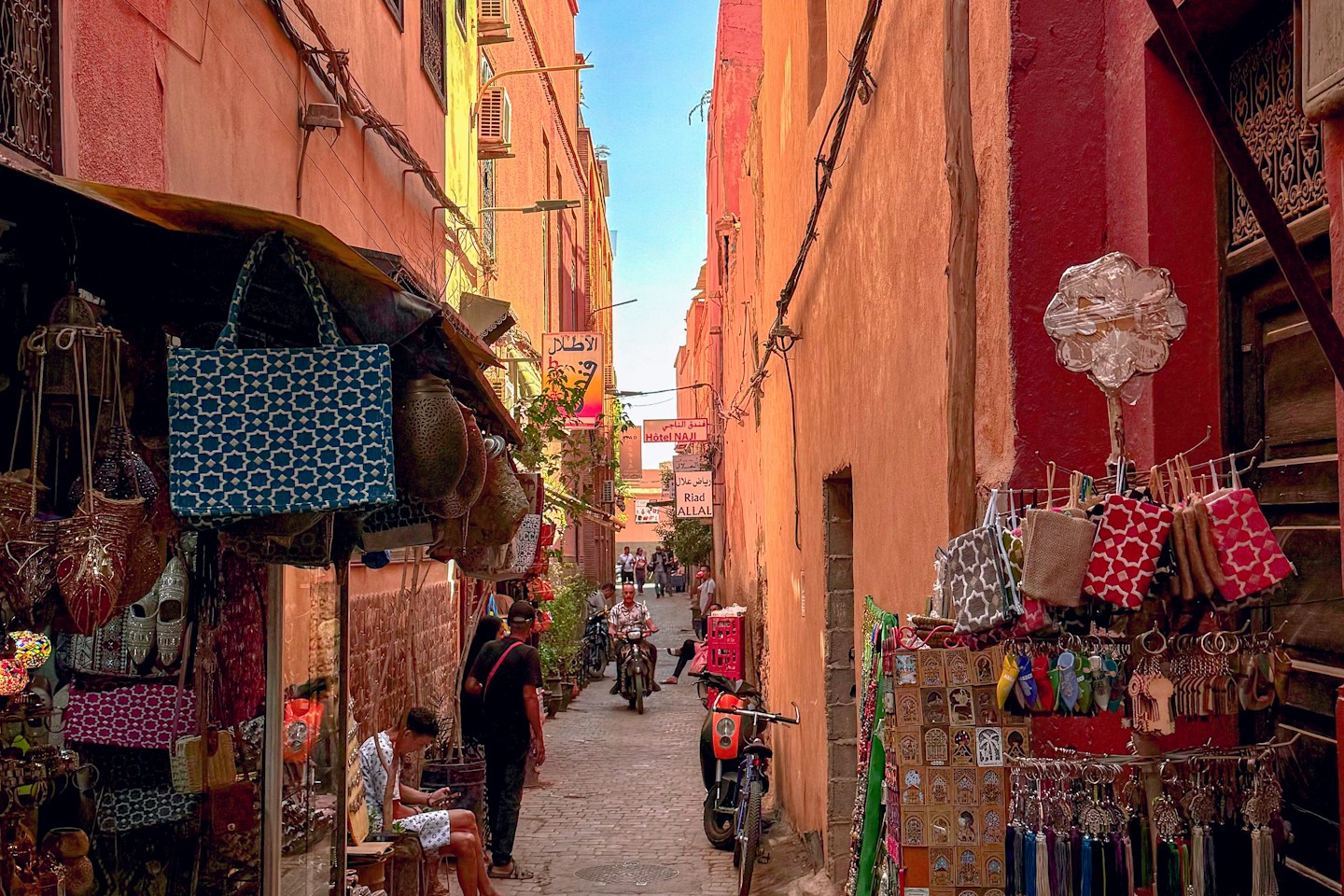
Medina lanes form a working urban network. They are not uniformly pedestrian-only, and people move through them for reasons unrelated to tourism. Stay attentive to vehicles, deliveries and others trying to pass. When stopping to look at a façade or consult directions, step aside. A group spread across the lane can create an obstruction without noticing how little usable space remains.
Choose a short route connecting a few known points, then extend it gradually on later outings. Returning along a familiar passage can be more useful than continuing into uncertainty simply to avoid repetition. A licensed guide can help with orientation and interpretation, provided the arrangement is clear. Explain whether the interest is history, architecture or craft, discuss the walking pace and ask how shopping stops are handled. A guided visit need not become a compulsory buying circuit. Equally, independent exploration need not become a contest in which asking for legitimate help feels like failure. The goal is enough confidence to remain curious, with attention available for details instead of being consumed entirely by the next turn.
Browse the souks without making every encounter a transaction
The souks reward looking slowly, but browsing becomes easier when you have a budget and an idea of what genuinely interests you. Before a serious purchase, ask about material, production and the full terms. Take time to compare your understanding with the object itself rather than allowing the pace of the conversation to decide. There is no need to purchase immediately because someone has been hospitable or spent time explaining a product.
A courteous refusal is sufficient when you do not want to continue. Avoid turning ordinary negotiation into either a theatrical contest or a confrontation. If shipping, customization or a later collection is involved, obtain the details clearly before paying. For workshops, distinguish observation of genuine work from a demonstration organized specifically for visitors, and ask before photographing people or equipment closely. Craft becomes more interesting when its materials and labor receive attention. The object you choose, if any, should carry that understanding home rather than merely represent a successful bargain. Leaving without a purchase can still be the right outcome of a worthwhile visit.
Give the courtyard its boundaries
A riad or courtyard can offer a quieter scale after the medina's movement, but private hospitality space is not automatically a public attraction. Visit places that clearly welcome guests or provide authorized access. Do not follow an open door into a residential interior because the courtyard looks photogenic. The relationship between the enclosed space and the street can be appreciated without crossing a boundary that has not been offered.
Religious places have their own access rules and expectations, which must be checked specifically. A building can be visually prominent and still not permit the entry you imagined. The Koutoubia's external setting, for example, can contribute to orientation without assuming interior access. Dress and photography should follow the place's guidance rather than a general impression of what other tourists are doing. This attentiveness improves understanding as well as behavior: thresholds, enclosure and the distinction between public and private are part of how the city works. A thoughtful visit notices those relationships instead of treating every attractive space as a room waiting to be entered.
Let a garden become the main outing
Gardens provide a different rhythm from the densest shopping lanes. Choose one that genuinely interests you, check its current entry arrangements and allow enough time to experience it. A reserved entry, where applicable, should not be squeezed between distant appointments with no margin for transport. Consider the route from the accommodation and the return in the conditions expected that day.
The garden outing can form the center of a lighter day, paired with lunch and one nearby walk. It does not need another major medina circuit immediately afterward. Notice how planting, shade, water and built elements organize attention, rather than using every attractive corner as the next portrait background. Stay on permitted paths and avoid obstructing shared spaces while taking pictures. Official destination information identifies settings such as Majorelle and the Menara among the city's varied places to explore: visitmorocco.com. Their role in an itinerary is not simply to provide relief from the city. They are part of its spatial variety and deserve the same curiosity offered to markets or historic interiors.
Use the seated break before you need it
For a meal with a specific Marrakesh connection, ask about tanjia. Morocco’s national tourism guide describes this local specialty as meat, traditionally lamb or veal, prepared in a terracotta jar. It should not be treated as merely another spelling of tagine. Couscous and pastilla belong to the broader culinary range encountered in the city, but each kitchen’s version and availability deserve their own questions. A patient lunch is a better setting for learning those differences than ordering several dishes as interchangeable samples. Start with the official food introduction at visitmorocco.com, then let the actual menu and cook explain what is being served.
A tea stop or meal can reset an overfull afternoon, particularly after prolonged walking and negotiation. Choose somewhere comfortable and understand what you are ordering before settling in. A clear question about the menu or price is ordinary planning, not a failure to embrace spontaneity. Explain dietary needs directly and ask about preparation where ingredients are uncertain.
Place the break before the point at which everyone becomes tired and irritable. A full day can be organized as two shorter walking periods separated by lunch and rest, rather than one continuous advance through the medina. Keep water available and adjust outdoor activity to heat and individual tolerance. Children or less mobile companions may need a much smaller radius than the most enthusiastic shopper. Discuss those needs openly at the start. The best pause is not necessarily the most famous terrace; it is one along a workable route where the group can sit without immediately planning another demanding connection. Comfort creates the attention needed to enjoy the next part of the city.
Leave with one route you know well
On the last day, repeat a manageable route rather than attempting to recover every missed landmark. Familiarity changes what you notice: a business opening, the quieter entrance to a lane or the way the square has shifted since the first visit. That recognition is a useful measure of a successful stay. It suggests that the city has begun to resolve into particular places rather than remain one generalized impression.
Check the departure pickup as carefully as arrival, including the point where luggage meets the vehicle. Allow time for the walking section and do not attach a final shopping task to a narrow transfer margin. Use official destination information for orientation and confirm current access with the responsible sites or accommodation. A well-paced Marrakesh visit holds intensity and quiet together: a souk conversation, a cultural explanation, a garden afternoon and a route home you understand. None needs to be maximized. Their value comes from being encountered with enough space to absorb what is happening and enough practical confidence to return when you want another look.
A few practical questions
What is the most useful arrival arrangement?
Obtain the exact vehicle drop-off, final walking route and meeting instructions from the accommodation. Confirm whether a transfer includes reaching the actual doorway.
How should a guided medina visit be agreed?
Discuss interests, walking pace, duration and the treatment of shopping stops in advance. A clear arrangement lets orientation and interpretation receive proper attention.
For current destination information, access guidance and local updates, visit the official Marrakesh travel resource. Check transport and attraction details directly before booking.
This is a general planning guide, not a live conditions report. Found something that needs updating? Send a correction.