Oaxaca’s markets, workshops and patient meals
Oaxaca rewards curiosity that extends beyond a plate of food. Pair city markets with cultural collections and community-led workshops, leaving enough time to ask how objects and ingredients are made.
Inside this story
Oaxaca rewards a visitor who asks how things are made. A market meal can lead to questions about a sauce; a woven object can lead toward a particular community rather than a generic souvenir category. The city is a useful base for those encounters, provided each is given enough time. Central streets, a cultural collection and an evening in Jalatlaco can fill a day without a regional transfer. Monte Albán and a workshop community deserve separate outings. Keeping these scales distinct creates a stay in which food, objects and place begin to explain one another, while leaving room for the ordinary pleasures of a long lunch and a familiar walk home.
- The central city makes a useful walking base for markets and cultural stops.
- A workshop visit is stronger when buying decisions respect the maker’s time.
- A slow lunch leaves a better opening for an evening walk than an overpacked afternoon tour.
Begin with a city day and an appetite
An arrival day should establish the relationship between accommodation, meals and the central walking area. Find a manageable first route and allow time to learn how the elevation and sun affect your energy. A short map distance can feel different after a journey, especially when several cultural stops and a large meal are added. Carry water, choose shade where possible and make the first afternoon easy to shorten.
A central base can make repeated short walks practical, but inspect the room's exact location and luggage access before booking. Think about the evening return as well as the morning departure. If a property lies in a quieter neighborhood, understand the actual route to the places where you expect to eat. Keep the first meal uncomplicated and do not treat the city's culinary reputation as a demand to begin with the most elaborate tasting experience available. Appetite, rest and orientation are resources to protect. They make the following days of markets, interpretation and regional travel more enjoyable than an arrival spent trying to prove immediate familiarity with everything Oaxaca is known for.
Walk the market as a place of work
Choose a market visit with a purpose: a meal, ingredients, a particular preparation or guided interpretation. Aisles are used by customers, vendors and people carrying supplies, so step aside when stopping to examine a display. Ask before close photographs, especially when the image includes a person at work. Do not treat a brief purchase as permission to occupy a counter indefinitely with questions during a busy period.
Observe how ordering and seating function before joining in. Clarify what is included and how the food is served rather than assuming a familiar restaurant arrangement. A guide can be useful for interpreting ingredients and introductions, provided the visit respects traders' time. Look beyond novelty: maize preparations, sauces and everyday portions can be as revealing as the item promoted most heavily to visitors. If buying ingredients, consider storage and the real possibility of using them during the stay. A bag of perishable food is not improved by being carried through a long afternoon tour. The market becomes a stronger experience when its ordinary commercial purpose remains visible and your own participation fits naturally within it.
Treat mole as a family of preparations
Mole does not identify one uniform sauce. Mexico's cultural resources describe Oaxaca through preparations including negro, amarillo, verde, coloradito and chichilo, while also making clear that the region's variety exceeds a simple canonical list. Different kitchens and communities bring different approaches. Begin with a few examples and ask about their preparation instead of trying to complete all possible names. The national cultural food overview provides a useful introduction: cultura.gob.mx.
A comparison becomes interesting when you notice texture, aroma and how the sauce relates to the rest of the dish, not merely its color. Do not assume that a darker preparation must taste like one already tried elsewhere. Allergies and dietary restrictions require direct discussion because sauces can contain numerous ingredients that are not visually obvious. Stocks, fats and accompaniments also matter. A tasting opportunity, where appropriately offered, can help explain differences, but a full meal remains valuable in its own right. Let one sauce occupy your attention without immediately judging it against every other version. Oaxaca's food becomes more intelligible through patient particular examples than through a ranking exercise conducted over a few crowded days.
Let a tlayuda become the meal
A tlayuda offers another route into the city's food culture, centered on a substantial maize tortilla and its preparation rather than on an intricate sauce alone. Ask how the establishment serves it and what toppings or accompaniments are included. Do not infer a complete ingredient list from the visible surface. The national cultural food resource identifies tlayuda with asiento among the city's preparations, a useful reminder that dietary questions may concern something beneath the most obvious toppings.
The practical pleasure is in giving the food time. Share where that is appropriate, choose the amount that suits your appetite and avoid scheduling another major tasting immediately afterward. A long lunch can be followed by a cultural interior, rest or a short walk instead of a transfer into the surrounding region. If joining a cooking experience, establish the content, duration and level of participation before booking. Watching, preparing and eating are different activities, and a class is most satisfying when its purpose is clear. You do not need to return home able to reproduce an entire cuisine. Understanding one technique or ingredient more fully is already a meaningful outcome.
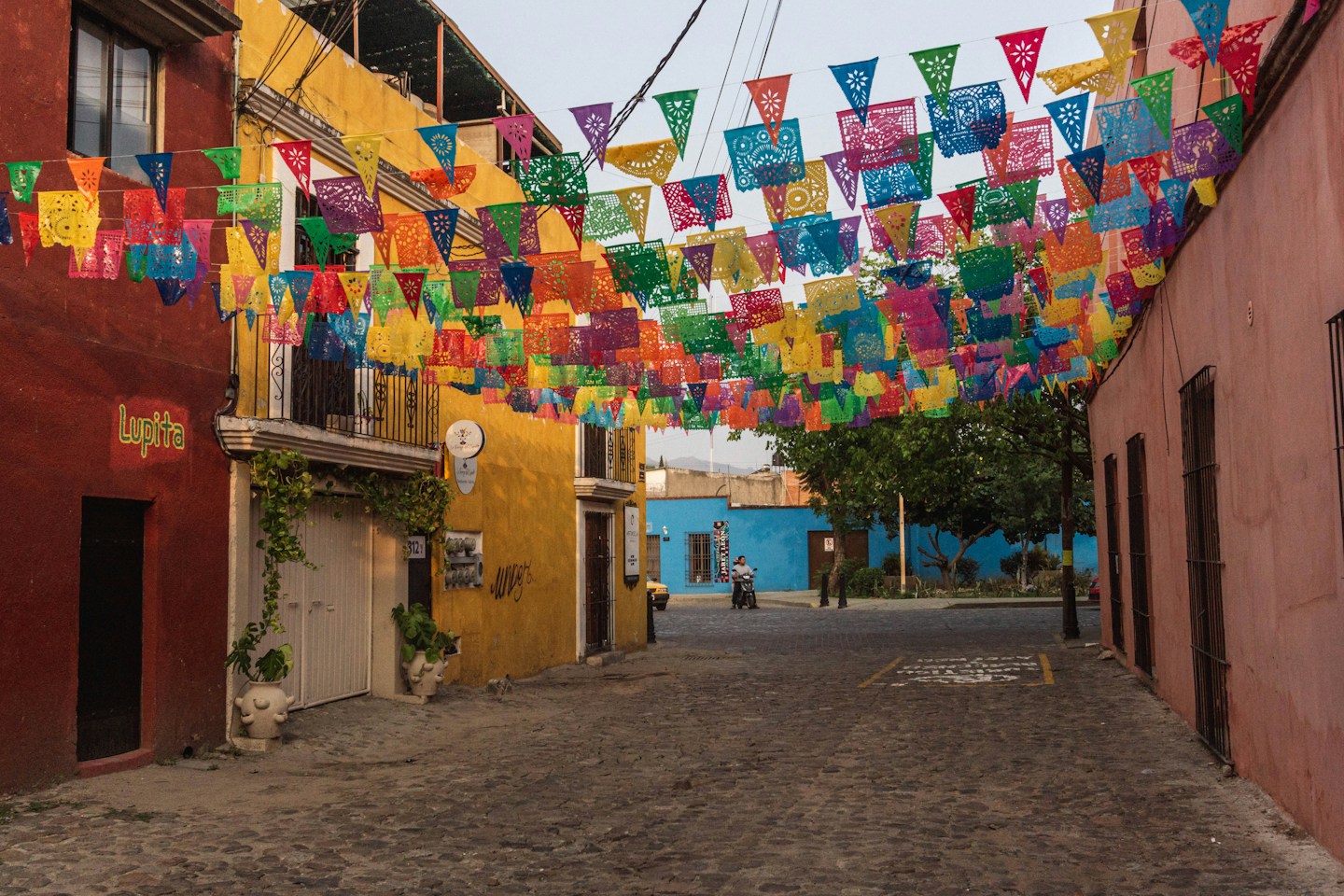
Find Jalatlaco beyond its colorful surface
Jalatlaco adds a neighborhood scale to a city stay. Its visual appeal invites photography, but the streets also contain homes, local movement and businesses that need access. Walk slowly, leave doorways clear and avoid arranging a group in a way that blocks the route. Ask before making close portraits or entering an interior, even when an open door reveals an attractive scene. A neighborhood is not a collection of backgrounds automatically available to the camera.
Choose a time when the walk will be comfortable, and let a café or meal provide a proper stopping place rather than pausing indefinitely outside someone's home. The state government recognizes San Matías Jalatlaco for its art, traditions and architecture, but the designation is an introduction rather than an instruction to pursue a fixed list of images. Notice how details work together: street surfaces, entrances, color and the places where people gather. Returning after another city day can be especially useful because the neighborhood then provides contrast and continuity. It helps the visit acquire an everyday rhythm beyond the central market circuit, with time to see a place without continually asking what major attraction comes next.
Choose the craft, then choose the community
Craft traditions should not be collapsed into one generalized shopping excursion. Teotitlán del Valle is associated with wool weaving and rugs, while San Bartolo Coyotepec is known for barro negro pottery. Their materials, processes and community settings differ. Choose the subject that genuinely interests you, then seek a community-led or maker-led visit that allows time for explanation. Oaxaca's official introduction to Teotitlán is a useful starting point: oaxaca.travel.
Discuss the arrangement before traveling. Ask whether the visit includes a demonstration, hands-on work or simply time in a workshop, and clarify how payment for that time is handled. A maker's explanation is labor even when no object is purchased. If considering a purchase, ask about materials, care and the process behind the specific piece. Avoid applying a generic bargaining routine to every workshop or treating the lowest possible price as the measure of success. A modest purchase made with understanding can be more meaningful than a large one acquired without context. Transport and packing deserve thought too, especially for fragile pottery or a textile that will travel onward with you.
Give Monte Albán its own horizon
Monte Albán is a separate archaeological outing, with exposed walking and a landscape whose scale cannot be understood as a quick addition after lunch. INAH identifies it as a major ancient Zapotec capital occupying a high setting above the surrounding valleys. Begin with that context, then use official interpretation to understand the relationship between structures and the wider site: lugares.inah.gob.mx.
Check current visitor arrangements and choose timing appropriate to conditions and the group's energy. Carry water and sun protection, and consider the surface, steps and distances involved. A person happy to walk around the city may find an exposed archaeological circuit more demanding. Keep to authorized routes and do not climb where access is restricted. Interpretation is particularly valuable here: the shape of a plaza or platform becomes more meaningful when its role is explained, while uncertainty should remain acknowledged rather than replaced by a dramatic invented story. Leave a quiet afternoon afterward. The city will still be available for dinner, and the pause gives the morning's much longer historical perspective time to settle.
Let celebrations set their own terms
A festival or community event can be memorable, but visitor access and photography should follow local guidance. Do not assume that an activity in a public-looking space is being staged for tourists or that a camera is welcome at every moment. Ask through the host, organizer or a knowledgeable local guide, and accept limits without trying another angle. The point is to understand what participation is appropriate, not merely whether entry is physically possible.
Use oaxaca.travel for official orientation and verify specific workshop, collection and archaeological arrangements directly. Keep the final day geographically simple, with time to collect bags and make the onward connection. A familiar meal and a neighborhood walk can be a better conclusion than another regional excursion. By then, the strongest discoveries should connect a preparation with a kitchen, an object with a maker and a neighborhood with ordinary life. Oaxaca offers far more variety than any short visit can absorb. A patient itinerary allows that abundance to remain generous, giving a few encounters enough depth that they are remembered as relationships rather than a list of things consumed.
A few practical questions
How should a workshop visit be selected?
Begin with the material or process that interests you, then arrange a maker-led or community-led experience. Clarify time, participation and payment before traveling.
Can Monte Albán fit casually between city activities?
It deserves a separate plan for transport, interpretation, exposed walking and recovery. Keep the remainder of the day light enough to enjoy the experience without rushing.
For current destination information, access guidance and local updates, visit the official Oaxaca travel resource. Check transport and attraction details directly before booking.
This is a general planning guide, not a live conditions report. Found something that needs updating? Send a correction.